
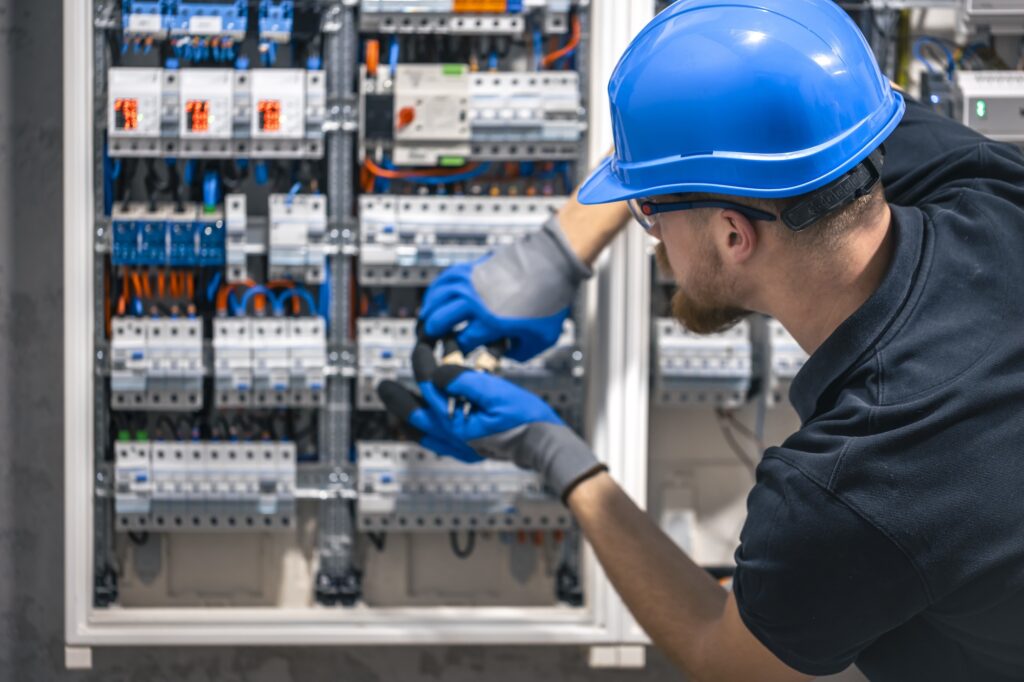
Photo credit: Energy Mechanical Services
By Kashan Ajmeri | Last updated: 27 October 2026
An electrician's most expensive problem is rarely a difficult repair. It is a phone that rings while both hands are in a panel, a quote that takes three days to send, and a customer who books the electrician who answered first. This guide compares the AI tools that actually help a small electrical shop — answering, estimating, dispatch, and reviews — and names what to buy first and what to skip until the business is bigger.
What are the best AI tools for electricians in 2026?
The best AI tools for electricians in 2026 are an AI phone-answering service such as Goodcall for missed calls, Jobber or Housecall Pro for quotes, scheduling, and invoicing, and an AI estimating tool such as Drawer AI or Trimble for commercial bid work. Start with call answering plus one field-service platform, and add estimating software only when bid volume justifies its cost.
Missed calls are the core problem. An analysis of over 60 million phone calls by call-tracking firm Invoca found that home service businesses miss around 27% of inbound calls, with each missed call costing roughly $1,200 in lost revenue on average (reported in Rise Digital Strategies, August 2026). That figure is an average across home services, not a promise for one electrical shop, but the direction is clear: the job goes to whoever answers. CallRail was reported in 2025 as finding that 82% of callers move to a competitor after one missed call (reported via VoiceAnna, October 2026).
Electricians face a specific version of this. One trade analysis put the electrical miss rate at 55–65%, blaming a high volume of small enquiries overwhelming solo operators (Contractor In Charge, missed-call statistics). Those figures come from vendor and agency sources, not a single audited study, so treat them as a warning sign, not a precise measurement of your business. Check your own call log for one week before buying anything.
How to choose: start from the job, not the tool
Split your work into four jobs: answer the phone, quote the job, run the day, and win the next job. Most small electrical shops need help with the first two first. A solo electrician does not need enterprise dispatch software. A 10-person commercial contractor does not need a solo-operator quoting app. Match the tool to crew size, and re-check that match every time you hire.
Comparison: best AI tools for electricians
| Job | Tool | Best for | Starting point (verify before buying) |
|---|---|---|---|
| Answer calls 24/7 | Goodcall | Small shops losing after-hours leads | Reported $49–$99/month in trade guides |
| Quotes, scheduling, invoicing | Jobber | Solo to 10-person residential shops | Core from $49/month, $29 on annual billing (Oct 2026 comparisons) |
| Quotes, scheduling, invoicing | Housecall Pro | 3–8 person teams, QuickBooks users | Basic from $79/month, $59 on annual billing (Oct 2026 comparisons) |
| Enterprise field service | ServiceTitan | 20+ technicians, dedicated office staff | Quote-only, per-technician pricing |
| Electrical estimating | Drawer AI | Commercial estimators, PDF takeoff | Check current pricing — demo first |
| Electrical estimating | Trimble / Accubid | Commercial bids, NECA labour data | Reported ~$3,000–$6,000/year depending on modules |
| Takeoff from drawings | STACK | Contractors bidding 10+ jobs a month | Reported $2,999–$4,999/year per estimator |
| Job photos & reviews | CompanyCam + NiceJob | Residential shops building Google reviews | Check current pricing — trial first |
Pricing in this table comes from October 2026 trade comparisons, not from the vendors' live pages at the moment of writing. Jobber and Housecall Pro figures were verified on vendor pricing pages on 3 October 2026 by one comparison guide (Home Service Operator Guide). Always re-check before buying: trade software prices change, and electrical pricing paths can differ from the headline prices shown before you select a trade.
1. AI phone answering: Goodcall
Goodcall answers inbound calls, qualifies the caller, and books appointments, including after hours. For an electrician, the value is simple: an emergency caller who reaches a helpful answer at 9 p.m. is a booked job, while the same caller reaching voicemail is a competitor's job. Set it up with your real service area, emergency rules, and price ranges, and test it yourself by calling from another phone. An AI receptionist that books jobs outside your area or promises prices you cannot honour will cost more than it saves.
2. Field-service platforms: Jobber vs Housecall Pro
Jobber and Housecall Pro cover the same core chain — quotes, scheduling, invoicing, payments, and customer history — with AI help drafting quotes and follow-ups. The October 2026 comparison found Jobber cheaper for a solo operator (Core $49 month-to-month, $29 annual equivalent) and Housecall Pro slightly cheaper for 3–5 person teams on some plans, with the difference too small to decide on price alone. Choose on workflow: Jobber is lighter to learn, Housecall Pro is stronger where QuickBooks, review collection, and marketing automation are central. Both offer 14-day trials. Run a real week of jobs through the trial, including a quote, a reschedule, and an invoice, before you commit.
ServiceTitan is a different class of software. It is built for larger operations with dedicated office staff, with per-technician quote-only pricing and annual contracts. A solo or small shop buying ServiceTitan early will pay enterprise prices for depth it cannot use. Grow into it, do not start with it. The same staged approach worked for neighbouring trades in our guides to AI tools for HVAC companies and AI tools for plumbing businesses.
3. Estimating and takeoff: Drawer AI, Trimble, STACK
Commercial electrical work lives or dies on takeoff speed and accuracy. Drawer AI detects power devices, lighting fixtures, and panel schedules on PDF drawings and generates conduit paths, according to trade coverage of its electrical features. Trimble's estimating tools add NECA labour-unit data and material pricing for commercial bids. STACK lets estimators count devices and measure conduit runs from uploaded plans. None of these replace an estimator's judgment on scope gaps, exclusions, site conditions, and margin. The right test is a trial on a drawing set you have already measured by hand: if the tool's count does not match yours, find out why before you trust it on a live bid.
4. Photos, documentation, and reviews: CompanyCam and NiceJob
CompanyCam keeps job photos organised by address and job, so the office, the technician, and the customer all see the same record. NiceJob automates review requests after a job. Together they solve a quiet problem: electrical work is mostly hidden inside walls and panels, so photos and reviews are the only proof a future customer can see. Ask for the review at the job, while the customer is happy, not in a bulk email a week later.
What to buy first, by crew size
Solo electrician (1 person): AI call answering plus Jobber Core or Housecall Pro Basic. One platform, one answering service, no estimating software until bid volume demands it.
Small crew (2–5 people): The same, plus CompanyCam for job photos and a review tool. Add an AI appointment-setter only if the office still misses calls during working hours.
Growing contractor (6–15 people): Re-examine the platform choice at this size, because per-user pricing changes the maths. Add estimating/takeoff software for commercial work, and formalise dispatch rules.
Large contractor (20+ people): ServiceTitan or an equivalent enterprise platform, with estimating software integrated. At this size, implementation help is worth paying for.
Mistakes that waste money
- Buying estimating software before you have enough bids to justify it.
- Letting an AI receptionist quote prices or promise arrival times you have not approved.
- Running two field-service platforms at once "just to compare" — pick one, run a real trial week, then decide.
- Ignoring the price book: AI-drafted quotes are only as good as your material and labour rates.
- Forgetting permits and safety: no AI tool replaces a licensed electrician's judgment, local code knowledge, or inspection requirements.
FAQ
Can AI answer emergency electrical calls?
AI answering can take the call, record the problem, and book or escalate it, but it cannot diagnose a fault safely or replace emergency advice. Set clear rules: genuine emergencies go to a human immediately, and the AI must never tell a caller to touch a panel or reset equipment unsafely.
Is Jobber or Housecall Pro better for electricians?
Neither wins for every shop. Jobber is cheaper and lighter for solo operators; Housecall Pro is stronger for teams that need QuickBooks sync and marketing automation. Trial both with real jobs and decide on workflow, not on a headline price.
Do electricians need AI estimating software?
Only if bid volume justifies it. Residential service work rarely needs takeoff software. Commercial contractors bidding regularly from drawings will usually recover the cost in estimator hours — but only if the tool's counts are checked against hand-measured drawings first.
Will AI replace electricians?
No. AI helps with calls, quotes, paperwork, and estimating. The physical work — inspection, installation, testing, and code compliance — still needs a licensed electrician on site. The electricians at risk are not those replaced by AI, but those whose competitors answer faster and quote faster.
Conclusion
For most small electrical shops, the winning combination is unglamorous: answer every call, quote the same day, and prove the work with photos and reviews. Start with AI call answering and one field-service platform, trial it on real jobs, and add estimating software when commercial bid volume earns it. That order — phone first, paperwork second, estimating third — is how a small shop stops losing jobs it never knew about. For the neighbouring trades, see our guides to AI tools for moving companies and AI tools for roofers, which face the same missed-call problem.
Another trade workshop facing the same missed-call and dispatch problems: see our guide to AI tools for bike shops.
Sources: Invoca call analysis via Rise Digital Strategies (August 2026); CallRail 2025 findings via VoiceAnna (October 2026); Contractor In Charge missed-call statistics; Home Service Operator Guide Jobber vs Housecall Pro pricing verification (3 October 2026); trade coverage of Drawer AI, Trimble, and STACK estimating tools. Vendor and agency statistics are reported as reported, not as audited measurements.