
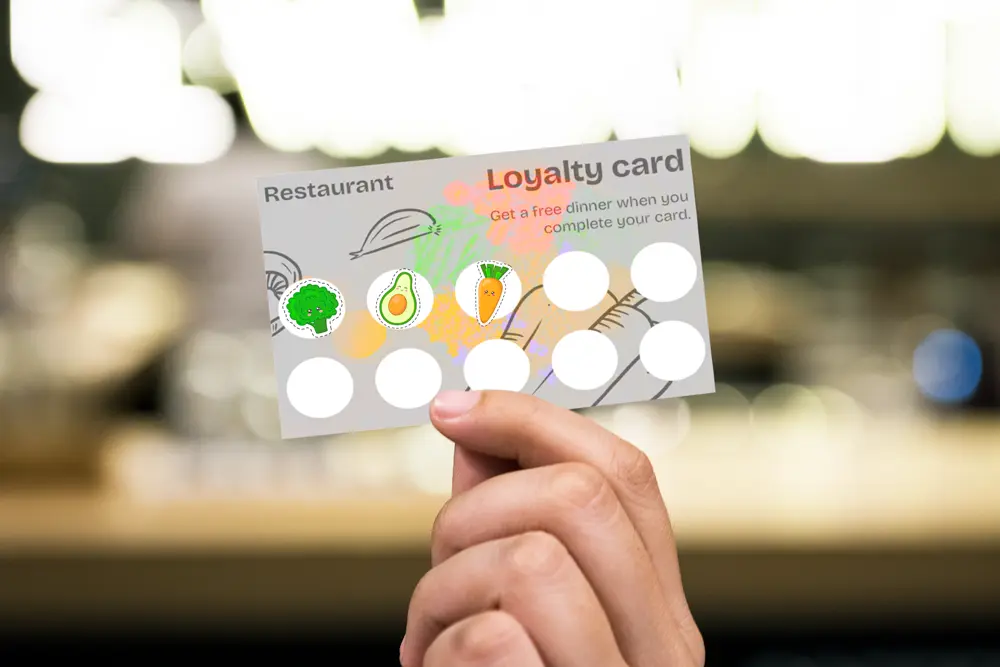
A restaurant loyalty card in a customer's hand. Photo: CopyDr.
Learning how to use AI to create a restaurant loyalty program is one of the fastest ways for a small restaurant to bring customers back without spending more on advertising. A good loyalty program rewards repeat visits, and AI takes over the repetitive work: tracking points, sending reminders, writing messages, and spotting which customers are about to stop coming. You do not need a big budget or a technical team. In this guide, you will learn the full process step by step, from choosing the right program type to launching it and measuring whether it works.
I have spent years marketing restaurants, and the pattern is consistent: winning a brand-new customer costs far more than bringing back someone who already liked your food. A loyalty program turns one-time visitors into regulars. AI simply makes the program cheaper and easier to run, which is exactly what a small restaurant needs.
Why a Restaurant Loyalty Program Works
Most restaurants lose customers quietly. A guest visits twice, enjoys the food, and then slowly drifts to another place. There is rarely a complaint — just silence. A loyalty program gives that guest a concrete reason to return: points, a free item, or a reward that is almost within reach.
Research on customer behaviour consistently shows that repeat customers spend more per visit than first-time visitors, and that a small increase in repeat visits can produce a meaningful increase in annual revenue. A loyalty program also gives you something advertising cannot: a direct line to your own customers. Instead of paying a delivery app or a social platform every time you want attention, you can reach members directly with an email or SMS.
AI does not change the basic idea. It changes the workload. Before AI tools, a small restaurant either ran a paper punch card or paid for an expensive platform. Now, affordable tools can handle enrolment, point tracking, reminders, and personalised offers automatically.
What AI Actually Does in a Loyalty Program
It helps to be clear about what AI can and cannot do. AI will not make customers love food they did not enjoy. What it does well is the operational work around the program:
- Enrolment and tracking: Customers join by scanning a QR code or entering a phone number. The system records every qualifying purchase and updates points automatically.
- Personalised messages: AI drafts welcome messages, points-balance reminders, birthday offers, and "we miss you" notes in your restaurant's tone.
- Smart timing: The tool can learn when a customer usually visits and send an offer just before that window, rather than blasting everyone on the same day.
- Churn signals: If a regular has not visited in 30 or 45 days, the system can flag them so you can send a win-back offer before they are gone for good.
- Reward suggestions: By looking at what members actually order, AI can suggest rewards that cost you little but feel valuable — for example, a free drink with a biryani rather than a blanket discount.
The rule to remember: AI drafts and tracks, but you decide. Always review automated messages and offers before they go out, and check that reward costs make sense for your margins.
How to Use AI to Create a Restaurant Loyalty Program: Step by Step
Step 1: Choose Your Program Type
Start with the structure, not the software. Most small restaurants succeed with one of these four models:
- Points per visit or per amount spent: For example, 1 point per $1 spent, and 100 points earns a $5 reward. Simple to explain and easy to automate. Best for cafes, fast-casual spots, and restaurants with frequent visits.
- Visit-based punch card (digital): Buy 9 coffees, get the 10th free. This is the easiest model for customers to understand and works well when your average ticket is similar each time.
- Tiered program: Regular, Silver, and Gold levels, with better perks at higher tiers. This suits restaurants with a mix of casual visitors and high-spending regulars.
- Cashback or stored credit: Members earn a small percentage back on every order. This feels concrete, but you must watch the cost carefully — even 5% adds up.
For a first program, keep it simple. A points model or a digital punch card is enough. You can add tiers later once you see real data on who your regulars are.
Step 2: Set the Reward Maths Before You Buy Anything
Before choosing a tool, do the arithmetic on paper. A loyalty program should cost roughly 2–5% of the revenue it touches. Work out three numbers:
- Average ticket: What does a typical customer spend in one visit?
- Visit frequency: How often does a regular come back in a month?
- Reward cost: What does the reward actually cost you — not its menu price, but its food cost?
Example: if your average ticket is $15 and a customer visits 4 times a month, a "free dessert after 8 visits" reward costs you the food cost of one dessert (perhaps $2–3) to protect roughly $120 of monthly revenue. That is a healthy trade. If instead you offer 20% off everything after 3 visits, the program will eat your margin. AI tools can model these numbers, but the decision is yours: never offer a reward you would regret if every member redeemed it tomorrow.
Step 3: Pick an AI Loyalty Tool That Fits Your Size
Choose based on how your restaurant actually operates. Key questions: do you have a POS system the tool must connect to? Do customers order mostly in-store, online, or through delivery apps? Do you need SMS, email, or both? A tool that cannot see your orders will need manual updates, which defeats the purpose.
See the comparison table below for the main options. Start with a free trial or a low-cost plan, and test with your own staff for a week before inviting real customers.
Step 4: Connect the Tool to Your Orders
Points must update automatically when a customer pays. The cleanest setup is a direct integration with your POS or online ordering system, so every order feeds into the loyalty record. If you take many walk-in cash orders, a QR code at the counter works well: the customer scans it after paying, and the visit is recorded.
Keep enrolment frictionless. Asking for a full name, email, birthday, and preferences on day one will lose people. A phone number or an email alone is enough to start. You can collect more later, once the member trusts you.
Step 5: Use AI to Write Your Program Content
This is where general AI writing tools genuinely save time. Use them to draft:
- A one-paragraph program explanation for your menu, counter sign, and Instagram bio.
- A welcome message that tells new members exactly how to earn their first reward.
- Points-balance reminders ("You are 20 points from a free dessert").
- Birthday and anniversary offers.
- Win-back messages for members who have not visited in a while.
Give the AI your restaurant's details — name, cuisine, tone, and the exact reward rules — and ask for short, plain messages. Then edit them in your own voice. Never let an AI tool send messages with invented rewards, wrong prices, or offers you did not approve. A single wrong "50% off" message can cost you real money and trust.
Step 6: Launch to Regulars First
Do not launch to everyone on day one. Invite your 30–50 most regular customers first, plus your staff. They already like you, so they will forgive small glitches and tell you what is confusing. Train your team on two things: how to explain the program in one sentence, and how to help a customer enrol in under a minute.
A simple launch script for staff: "We just started a rewards program — you earn points on every visit and get a free dessert after 8 stamps. Want me to sign you up? It takes 20 seconds." Put a QR code on the counter, on receipts, and on one Instagram post. That is enough for a soft launch.
Step 7: Automate Follow-Ups and Win-Backs
Once the program is running, turn on the automations that make AI worth it:
- After first enrolment: a welcome message within an hour.
- Near-reward nudge: when a member is one visit away from a reward, remind them.
- Inactivity alert: after 30 days without a visit, send a friendly "we miss you" offer.
- Birthday offer: a small free item during their birthday week.
- Post-reward thank-you: a short note after they redeem, inviting them to start the next reward.
Keep the frequency low — one or two messages per month per member is plenty. Loyalty messages should feel like a thank-you, not spam. Always include a clear way to opt out.
Step 8: Measure, Then Improve
Check these five numbers every month:
- Enrolment rate: what share of customers joined?
- Active rate: what share of members earned or redeemed in the last 30 days?
- Visit frequency: do members visit more often than non-members?
- Average ticket: do members spend more per visit?
- Redemption cost: what did redeemed rewards actually cost you, as a share of member revenue?
If enrolment is low, the sign-up is too complicated. If active rate is low, the first reward is too far away. If redemption cost is high, the reward is too generous. Change one thing at a time, wait a month, and compare. That is how a small program gets steadily better.
AI Loyalty Tools for Restaurants Compared
The table below covers the main options a small restaurant would realistically consider. Pricing changes often, so confirm the current price on the vendor's site before committing. "AI features" here means automation, personalised messaging, or behaviour-based triggers — not just a digital punch card.
| Tool | Best For | AI / Automation Features | Starting Price (approx.) | Watch Out For |
|---|---|---|---|---|
| Square Loyalty | Restaurants already using Square POS | Automatic points, visit tracking, custom rewards, email offers | Paid add-on to Square (check current pricing) | Works best inside the Square ecosystem |
| Loopy Loyalty | Digital stamp cards for cafes and small restaurants | Digital punch cards, automated messages, Apple/Google Wallet cards | Free trial, then paid plans | Simple by design — limited tiers |
| Stamp Me | Simple stamp-card programs | Digital stamps, push messages, basic analytics | Free plan available, paid plans for more features | Less suited to complex tiered programs |
| TapMango | Restaurants wanting a fuller loyalty + marketing platform | Segmentation, automated campaigns, ordering integration | Paid plans (quote-based in some cases) | Can be more than a small restaurant needs |
| Glue | Small businesses wanting AI-driven retention | Automated win-back offers, personalised rewards | Paid plans | Check POS integration for your setup |
| ChatGPT / Claude + Canva | Writing messages and designing loyalty cards/signs | Drafting program copy, signs, emails, and social posts | Free tiers available; paid plans around $20/month | These do not track points — pair with a loyalty tool |
The practical takeaway: if you already use Square, Square Loyalty is the lowest-friction choice. If you want a simple digital punch card, Loopy Loyalty or Stamp Me will get you live quickly. Use ChatGPT or Claude alongside any of these to write the messages, and Canva to design the card and counter sign.
Common Mistakes to Avoid
- Making the first reward too far away. If a customer needs 15 visits for anything, most will never try. Let members earn something small by visit 3 or 4.
- Over-discounting. A loyalty program that is mostly discounts trains customers to wait for discounts. Mix in non-discount rewards: early access to a new dish, a free drink, or a members-only tasting.
- Letting AI send unchecked messages. Review every automated message template. One wrong reward value can be expensive.
- Forgetting staff training. If your team cannot explain the program in one sentence, customers will not join.
- Ignoring privacy. Only collect the data you need, explain what you will send, and make opting out easy. This builds trust and keeps you on the right side of privacy rules.
- Never checking the numbers. A program that runs on autopilot without monthly review can quietly lose money. The five metrics above take 20 minutes a month.
A Simple 2-Week Launch Plan
Week 1: Choose the program type, set the reward maths, and pick a tool. Connect it to your POS or set up the QR code. Write the welcome message, the points reminder, and the win-back message with an AI writing tool, then edit them yourself. Enrol your staff and test every step with real orders.
Week 2: Soft-launch to your regulars. Put the QR code on the counter and receipts, and post once on Instagram. Watch enrolments daily and fix any confusion. At the end of the week, check your first numbers and adjust one thing — usually the sign-up wording or the distance to the first reward.
That is the whole launch. You can be live in two weeks with a free trial and a few hours of setup.
Frequently Asked Questions
How much does an AI loyalty program cost a small restaurant?
Many tools offer free trials or starter plans, and a simple digital stamp-card tool can cost less than a typical day of advertising. The real cost is the rewards themselves, which you control. Budget 2–5% of member revenue for rewards, and confirm tool pricing on the vendor's site before you commit.
Do I need an app for my restaurant loyalty program?
No. Most modern loyalty tools work through a QR code, a phone number, or a digital wallet card — customers do not need to download your app. This is one reason enrolment is higher than it used to be: joining takes seconds.
Can AI write all my loyalty messages?
AI can draft them quickly, but you should always review and edit before they are sent. Check the reward, the expiry, and the tone. Your messages should sound like your restaurant, not like a generic template.
What reward works best for a small restaurant?
A low-cost, high-perceived-value reward works best — a free drink, a free dessert, or a small appetiser after a reasonable number of visits. It feels generous to the customer but costs you only the food cost, not the menu price.
How do I stop customers from gaming the program?
Set simple rules: one reward per visit, points expire after a stated period (for example, 6–12 months), and rewards cannot be combined with other discounts unless you say so. Most loyalty tools enforce these rules automatically once you set them.
Will a loyalty program work for a restaurant that relies on delivery apps?
It can, but it works best when it drives direct orders. Offer slightly better rewards for direct orders (in-store or through your own ordering link) so the program also reduces your dependence on delivery-app commissions.
Conclusion
Knowing how to use AI to create a restaurant loyalty program comes down to a simple sequence: pick a program type your customers can understand in ten seconds, set reward maths that protect your margins, choose a tool that connects to your orders, let AI draft the messages and automate the follow-ups, and review the numbers every month. You do not need a large budget or a technical team — a small restaurant can be live in two weeks. Start with your regulars, keep the first reward within reach, and let the program grow as your data tells you what your customers actually want.
By Kashan Ajmeri — restaurant marketer with 5+ years of experience helping restaurants grow through social media, menus, and customer retention.