
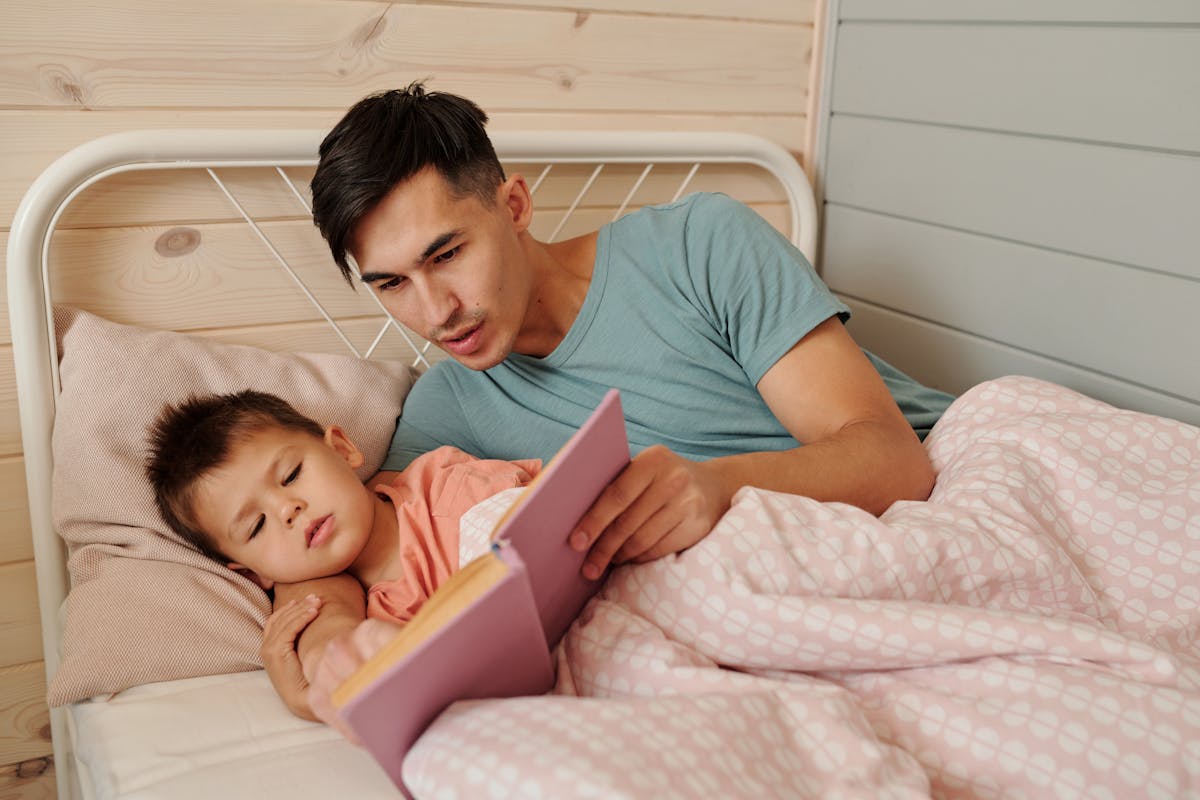
Photo credit: Pexels
By Kashan Ajmeri | Last updated: 4 November 2026
One night, from the hallway outside her second-grader's bedroom, writer Sophie Brickman heard her daughter order a bedtime story so specific it sounded like a dare: mowing lawns in a place called Bananaland, with a festival, and monkeys — and make it funny. Her husband, a venture capitalist with no storytelling ambitions, cleared his throat and delivered. There was a clever girl, a lawnmower called the Banana Blade, mischievous monkeys throwing banana peels, and a riddle delivered in rhythm and rhyme. Brickman, a professional writer, stood in the hallway genuinely stunned. Then her husband whispered the secret: "It's ChatGPT. I just feed in her insane prompts and it spits out a story."
That scene, from Brickman's December 2023 piece in The Guardian, is the question most parents are actually asking when they type it into Google. Not "can a chatbot generate text" — obviously it can. The real question is whether the story it writes is any good at 8 pm, when you are exhausted, your child is wired, and the wrong ending means another twenty minutes of awake.
Can ChatGPT help me write a bedtime story for my child?
Yes — ChatGPT can write a bedtime story for your child in under a minute, personalised with their name, their favourite animal and the thing they are worried about, and the free version is all you need. But do not read it straight off the screen. Read it yourself first, cut anything scary or preachy, and — this is the part that matters most — stop before the ending and let your child finish it. Used as a first-draft machine with a parent in charge, it works. Used as a replacement storyteller, it goes flat fast: Brickman's own daughter stopped asking for the AI stories within a couple of weeks, calling them "repetitive".
The numbers: parents are already doing this, quietly
If you feel slightly guilty about the idea, you are in very large company. A survey of 1,004 American parents by Lurie Children's Hospital of Chicago, published in May 2026, found that 81% of parents have used AI for parenting tasks — and nearly one in three (31%) said they had followed AI's advice over their own instincts. That is not a niche of early adopters. That is most parents.
The UK numbers tell the same story from the reading side. The National Literacy Trust's 2026 research, based on a survey of 3,073 parents of children aged 5 to 18, found that around two in three families (67.8%) had used AI together in some capacity — and 12% of families said they write stories together with AI. And the children are meeting AI early whether parents plan it or not: Common Sense Media's 2025 Census, surveying 1,578 parents of children aged 0 to 8, found that 29% said their child had already used AI for school-related learning. ZERO TO THREE's 2026 survey of about 2,200 US parents of children aged 1 to 5 found 18% typically use AI for parenting advice, and 76% of those parents found the advice helpful.
So the question is not whether AI belongs at bedtime. It is already there, in most homes, in one form or another. The question is how to use it without letting it do the part that actually matters — the part where you and your child make something up together.
The 5-minute test: the same prompt, three chatbots
Most guides about AI bedtime stories never actually test the tools. They tell you to "just ask ChatGPT" and move on. That is not enough, because the three big chatbots write very differently — and at bedtime, the difference between a good story and a bad one is not the plot. It is whether the story leaves room for your child.
In February 2026, the Substack publication The Slow AI ran exactly this test, with early-childhood educator Carla Engelbrecht. One prompt, three chatbots, same brief:
"My 4-year-old loves amusement parks. Give me a three-sentence bedtime story set-up that ends before the resolution so we can finish it together."
Here is what each one actually produced — quoted from the published test, not summarised.
Gemini (Thinking Model): "Benny the Bear ran all the way to the Glitter Fun Park to ride the magical merry-go-round, but when he got there, all the painted horses were fast asleep! He tried tickling their noses and singing a loud song, but they just kept snoring away. Suddenly, Benny remembered the one secret thing that always wakes up a magic horse, so he…"
ChatGPT 5.2: "Once there was a four-year-old who fell asleep every night dreaming of twinkling lights, whirring rides, and the happy music of an amusement park after dark. One evening, just as the moon rose over the tallest roller coaster, the rides suddenly stopped and a tiny glowing gate appeared where the merry-go-round used to be. The gate slowly creaked open, and from inside came a sound that made the child sit straight up and whisper, 'Should we go in?'"
Claude Opus 4.5: "Once upon a time, a little bunny named Pip went to the carnival and couldn't decide which ride to try first — the spinning teacups or the big bright Ferris wheel that touched the clouds. Just as Pip hopped toward the teacups, a friendly mouse ran up holding a golden ticket and said, 'This ticket lets you ride something secret, but we have to find it together!' Pip looked at the teacups, then at the mouse, then at the mysterious ticket sparkling in the moonlight... What do you think Pip does next?"
Same prompt, three completely different invitations. And the analysis is the part worth reading slowly, because it is about your child, not the software.
The Slow AI's verdict was that ChatGPT's version is a conversational dead end: beautiful, but it ends on a yes-or-no question — "Should we go in?" — which asks for permission, not imagination. The child is clicking "next episode" rather than writing the script. Gemini's version stops mid-sentence — "so he…" — which is a classic literacy tool called a sentence stem. The story literally cannot continue until the child invents the secret thing. And Claude's version gives the child a decision between two desires, the familiar teacups or the mysterious ticket, which asks them to be the director and imagine two different futures.
Put plainly: one asks for permission, one for a decision, one for invention. For a bedtime story, invention wins. A child who has to invent the next line is a child who is participating, not just listening — and a participating child falls asleep faster than a passive one, because the story belongs to them.
Here is how I would score the three on the things that actually matter at bedtime:
| Chatbot | Length for a 4-year-old | Calming ending | Room for the child |
| Gemini | Good — three sentences, reads aloud in under a minute | Good — sleepy horses, gentle humour, no threat | Best — stops mid-sentence, child must invent |
| ChatGPT | Longest — rich, but the most words to get through | Mixed — a glowing gate and a strange sound can feel spooky at 8 pm | Weakest — ends on yes/no, not an open question |
| Claude | Good — three sentences, clear scene | Good — friendly mouse, no danger | Strong — a real choice between two futures |
None of the three is wrong. But if you run this test yourself tonight — and you should, it takes five minutes — try the same prompt in all three and watch which one your child grabs. The answer will tell you more about your child than about the software.
Three copy-paste prompts that actually work
The prompt is the whole game. If you have ever typed "can ChatGPT help me write a bedtime story for my child" into Google, you already know the first answer is not the hard part — the hard part is getting a story that fits your child. "Write me a bedtime story" gives you a generic tale about a brave little hero learning a lesson, because that is the average of every bedtime story the model has ever seen. The trick is to give it constraints — your child's age, one interest, one gentle problem, and an instruction to stop early. Copy these, fill in the brackets, and change only the details.
Prompt 1 — the story starter (the one to use most nights):
"My [age]-year-old loves [interest, e.g. dinosaurs] and is a bit afraid of the dark. Give me a three-sentence bedtime story set-up that ends before the resolution so we can finish it together. Keep it calm and gentle, no scary characters, no villains, and end mid-sentence so my child has to invent what happens next."
The "ends before the resolution" line is doing the heavy lifting. Without it, the chatbot will wrap everything up neatly — problem introduced, problem solved, moral delivered — and there will be nothing left for your child to do except listen. With it, you get a beginning and a gap. The gap is the point.
Prompt 2 — the full story, for nights when you have no energy left:
"Write a short bedtime story, about 300 words, for a [age]-year-old who loves [interest]. The hero should be a child like mine, the problem should be small and solvable (lost toy, a dark hallway, a storm), and the ending must be calm and sleepy — the hero is safe in bed by the last line. No villains, no danger, no moral lesson spelled out at the end."
Use this one sparingly. A full story with a ready-made ending is convenient, and on a truly exhausted night that is fine. But notice what the Brickman story teaches: her daughter got bored of the AI stories within weeks because they were repetitive — same structure, same moral, same tidy ending. If you use the full-story prompt every night, your child will notice the pattern before you do.
Prompt 3 — the "finish it together" prompt (my favourite):
"Give me a bedtime story opening of two sentences about [child's first name or a character name] and [interest]. Then stop and ask my child two questions: what should the character do next, and what is the one secret thing only they know? Do not continue the story yourself."
This is the method behind the Ramos story from the Reddit thread that started this whole topic: Bri Ramos of Oklahoma City asks ChatGPT's voice feature to tell a story starring her six-year-old daughter Camilla — a little girl who is a princess, or maybe a dragon fighter — and then has it ask reading-comprehension questions afterwards. The story is the excuse. The conversation is the literacy lesson. A Texas dad went viral with the same idea in 2023, asking ChatGPT for stories built around his kids' chosen character names, a location, and a real issue they were working through — "include some underlying messaging about not being a jerk to your brother". The parents who love this method are not the ones who want a perfect story. They are the ones who want a starting point that gets their child talking.
ChatGPT vs Gemini vs Claude for bedtime stories
All three have free tiers that cost $0, and all three can write a bedtime story. Prices checked 4 November 2026: ChatGPT Plus is $20 a month, Claude Pro is $20 a month, Google AI Pro is $19.99 a month — but you do not need any of them for this. The differences are in how they write, not whether they can.
| Tool | Free tier | Best for bedtime stories | Watch out for |
| ChatGPT | $0 | Richest language and best voice mode — the Ramos mum uses ChatGPT's voice feature to tell stories aloud, which keeps your hands free and the phone face-down | Most likely to finish the story for you with a tidy moral; add "stop before the ending" every time |
| Gemini | $0 | Best cliffhangers — in the published prompt-off it stopped mid-sentence, which forces your child to invent the next line | Can drift into silliness that wakes a child up instead of settling them; check the tone before reading aloud |
| Claude | $0 | Best at giving the child a real choice between two futures, and the cleanest, most natural bedtime tone | Free tier has tighter usage limits; a long back-and-forth of story requests can hit the cap mid-evening |
My honest take: use whichever one you already have open. The prompt matters ten times more than the model. But if you want the single best setup for a 4-year-old, it is Gemini for the cliffhanger, read aloud by you, with your child inventing the ending. If you want the easiest hands-free version, it is ChatGPT's voice mode — with the phone face-down, so the story comes from the room, not from a glowing screen.
The 5-point audit before you read it aloud
Never read an AI story to your child straight off the screen. Read it yourself first — it takes thirty seconds — and run this checklist. Brickman's husband learned this the hard way: his ChatGPT draft for the two-year-old tried to retell Goodnight Moon with trucks, which missed the point entirely, because for a two-year-old the book is about curling up in a lap and looking at comforting illustrations, not the prose. And his Swiss Family Robinson prompt came back with the family "dancing whimsically in the glow of neon signs" in Times Square — which, as Brickman put it, would make the original author roll over in his grave, "right up there with eating roast penguin".
- Is it the right length? A 3-year-old needs about 3 minutes read aloud — roughly 300 words. A 6-year-old can handle 5 to 8 minutes. If the story runs long, ask the chatbot to cut it in half before bedtime, not during.
- Is anything scary? Chatbots love mild peril — dark forests, strange sounds, a character who is lost. At 8 pm, "lost" is not an adventure, it is a worry. Delete any threat, or swap it for something gentle.
- Did it reuse the same names? Left to itself, AI reaches for the same handful of names — Lily, Sophie, Tom — and the same brave-little-hero template. If the story does not use your child's details, it is not personalised, it is a template with your child's hobby pasted in. Ask for the character to be named after your child, or better, let your child name the hero.
- Is there a moral stapled to the end? "And so they learned that sometimes the silliest moments create the most magical memories of friendship" — that is a real line from one of Brickman's AI stories, and it is exactly the kind of sentence that makes a child glaze over. A story that teaches is fine. A story that announces its lesson is a lecture in a costume. Cut the last line if it lectures.
- Did it actually use your details, or invent generic ones? Check that the dinosaur is the kind your child likes, the fear is the one they actually have, and the setting is somewhere they recognise. Generic details are the tell that the AI was writing on autopilot.
What works at 3–4 vs 6–8
Age changes everything about this. What works for a four-year-old will bore an eight-year-old, and what thrills an eight-year-old will keep a four-year-old awake.
At 3–4, keep it short, repetitive and safe. One gentle problem, one friendly helper, a calm ending in bed. Repetition is a feature, not a bug — toddlers want the same story again, and AI is actually good at producing small variations on a theme. ("Same dinosaur, but tonight he is afraid of thunder instead of the dark.") But watch the length: a two-year-old does not need a story at all, really — they need the lap, the voice and the pictures. Brickman's experiment proved that. If your child is under three, the AI story is the wrong tool; read a real picture book instead.
At 6–8, make your child the hero and add questions after. This is the Ramos method, and it is the smartest use of AI at bedtime I have seen: the story stars the child, and when it ends, the chatbot asks comprehension questions — what did the character decide, why did they choose that, what would you have done? A six-year-old who has to explain a character's choice is practising reading comprehension without knowing it. You can also let an older child write the prompt themselves, which turns bedtime into a small writing lesson: what details do you need to give the machine to get the story you want?
The safety rules, stated plainly
None of this works if the safety basics are wrong, so here they are without softening. Never type your child's full name, school, address or photos into a chatbot — a first name or a made-up hero name is enough, and it is all the AI needs. Do not let a young child chat with the AI alone. ChatGPT's own terms set the minimum age at 13, and the Ramos mum runs the voice feature herself while her daughter listens — the parent is the operator, the child is the audience. And read the story yourself first, every time. The AI will sometimes slip in something odd — a roast penguin in a book about good little mothers, a family dancing under neon signs in Times Square — and at bedtime, "odd" lands harder than it does at noon.
One more thing worth saying out loud: the San Francisco dad who went viral for letting a chatbot read bedtime stories to his newborn in his own cloned voice drew about 4.5 million views and a wave of criticism, and the criticism had a point. A newborn does not need a story. A newborn needs a parent's voice, live, in the room. AI bedtime stories are for children old enough to follow a plot and young enough to still want one — roughly three to eight. Outside that window, put the phone away.
So, should you use ChatGPT for bedtime stories?
Yes — with the one condition this whole article has been building toward. Use it the way the best parents in these stories use it: as a fast first draft and a prompt for conversation, checked by a person who knows the child. A three-sentence setup from Gemini, finished by your child, beats a polished five-minute story read off a screen. The magic was never in the story the AI tells. It is in the gap it leaves for your child to fill — and in the twenty minutes afterwards, when the lights are low, the story is theirs, and you are the one reading it.
Try the five-minute test tonight. Same prompt, three chatbots, one child. Watch which ending they grab. Then put the phone face-down and let them finish it. That is the whole method, and it is the only part no software can do for you. The same "AI opens, a human finishes" rule works for grown-up writing too — see how to write an apology letter with AI that still sounds like you.
A personalised storybook with your child's name in it also makes a gift they will ask for again and again — and for the person who already has everything, our guide shows how to find gift ideas for someone who has everything with ChatGPT.
Frequently asked questions
Can ChatGPT help me write a bedtime story for my child?
Yes. ChatGPT can write a personalised bedtime story in under a minute, and the free version is enough. Read the story yourself first, cut anything scary or preachy, and stop before the ending so your child can finish it — that is what turns a generated story into a shared one.
Is it OK to use AI for bedtime stories, or does it replace the parent?
It depends entirely on how you use it. If the chatbot tells the whole story while you scroll your phone, it replaces you — and children notice, as one girl did when she called the AI stories "repetitive" after two weeks. If the AI writes the opening and you and your child invent the ending together, it supports the moment instead of replacing it.
Which AI is best for bedtime stories — ChatGPT, Gemini or Claude?
In a published February 2026 prompt-off on the same bedtime brief, Gemini gave the best cliffhanger (stopping mid-sentence), Claude gave the child the best choice between two futures, and ChatGPT gave the richest language but ended on a yes-or-no question. All three have free tiers. The prompt matters more than the model.
What age is AI OK for bedtime stories?
Roughly ages 3 to 8. Under three, children need the lap, the voice and the pictures of a real book, not generated text. At 6 to 8, you can make the child the hero and add comprehension questions after the story. ChatGPT's own terms set the minimum age for its service at 13, so the parent should always be the one operating it.
Should I put my child's real name into ChatGPT?
No — use a first name only, or a made-up hero name. Never type a child's full name, school, address or photos into a chatbot. A first name is all the AI needs to personalise the story.
Related guides on AI Tools Hub
- Can AI Help Me Write a Complaint Letter to a Company? (Yes — If You Audit It First)
- How to Use AI to Create a Study Timetable You'll Actually Follow
- How to Use AI to Plan a Road Trip Itinerary (Without Ending Up at a Closed Gate)
Sources
- Lurie Children's Hospital of Chicago — "AI and Parenting: Statistics on Usage, Benefits & Concerns" (survey of 1,004 US parents, published 14 May 2026): https://www.luriechildrens.org/en/blog/ai-parenting-statistics/ (81% use AI for parenting tasks; 31% followed AI advice over their instincts — checked 4 November 2026)
- National Literacy Trust — "Young people, teachers' and parents' use of AI to support literacy in 2026" (survey of 3,073 parents, published 18 August 2026): https://literacytrust.org.uk/research-services/research-reports/young-people-teachers-and-parents-use-of-ai-to-support-literacy-in-2026/ (67.8% of families used AI together; 12% write stories together — checked 4 November 2026)
- Common Sense Media — "The 2025 Common Sense Census: Media Use by Kids Zero to Eight" (survey of 1,578 parents): https://thejournal.com/articles/2025/03/11/research-1-in-3-kids-use-ai-for-learning.aspx (29% said their child had used AI for school-related learning — checked 4 November 2026)
- ZERO TO THREE — First Voice National Parenting Survey 2026 (about 2,200 parents of children aged 5 and under): https://www.zerotothree.org/parentsurvey/ (18% typically use AI for parenting advice; 76% of those find it helpful — checked 4 November 2026)
- The Slow AI — "AI Can Start the Story. Your Child Should Finish It." (prompt-off: ChatGPT vs Gemini vs Claude, 3 February 2026): https://theslowai.substack.com/p/ai-bedtime-stories-shared-invention (all three quoted story set-ups and the verdict — checked 4 November 2026)
- Sophie Brickman — "I was shocked: my husband was using AI to write our children's bedtime stories" (The Guardian, December 2023): http://www.richardhartley.com/2023/12/i-was-shocked-my-husband-was-using-ai-to-write-our-childrens-bedtime-stories/ (Bananaland story, roast penguin, "repetitive" verdict — checked 4 November 2026)
- USA News Hub — "ChatGPT, cooking and Christopher Walken: how parents got their kids to love reading in 2025" (Reddit r/books thread, 29 December 2025): http://www.allusanewshub.com/2025/12/29/chatgpt-cooking-and-christopher-walken-how-parents-got-their-kids-to-love-reading-in-2025/ (Bri Ramos / Camilla story — checked 4 November 2026)
- Macaroni KID — "A ChatGPT Parenting Hack You'll Want to Try" (Texas dad Gavin Braman's personalised-story hack, 2023): https://nashua.macaronikid.com/articles/643d6c8010214048481b600d/a-chatgpt-parenting-hack-youll-want-to-try (checked 4 November 2026)
- ChatGPT vs Claude vs Gemini plans and prices, October 2026: https://pandromeda.com/ai/chatgpt-vs-claude-vs-gemini-every-plan-and-price-compared (free tiers $0; Plus $20; Claude Pro $20; Google AI Pro $19.99)